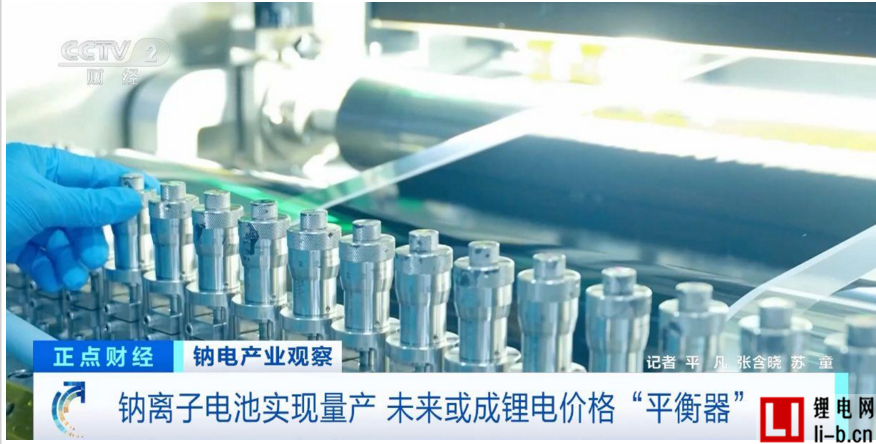
With the world's first GWh-scale sodium-ion cell line now operating in Fuyang, Anhui, sodium batteries are accelerating into energy storage and logistics — and could help tame the wild swings of lithium battery prices.
Sodium-ion batteries are moving faster into energy storage and logistics applications, driving fresh demand for battery output. Just how much production capacity does China have today, and how large could the market become?
In Fuyang, Anhui Province, the world's first GWh-scale sodium-ion cell production line is already in operation. Its manufacturing process resembles that of lithium-ion batteries, covering slurry mixing, coating, assembly and other stages.
Cost remains the key challenge for now. Industry data shows sodium-ion storage still costs significantly more than lithium-ion storage: lithium-ion energy storage cells average around 0.32 yuan per watt-hour, while sodium-ion cells run roughly 0.5 yuan/Wh or higher. As applications and capacity expand, the gap is expected to narrow.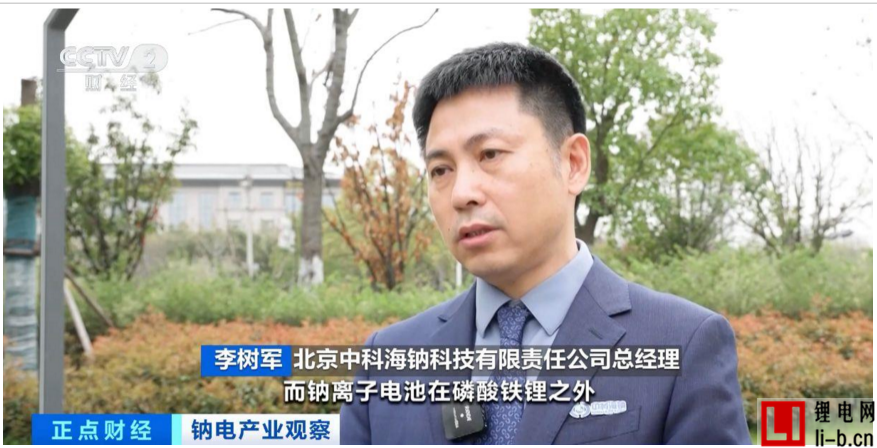
Tang Liang, deputy secretary-general of the China Energy Storage Alliance (CNESA): "As the scale of sodium-ion batteries grows, their price and cost will trend downward. We believe sodium-ion batteries can eventually build a cost advantage over lithium-ion batteries."
On the supply side, China's built and under-construction sodium-ion production capacity is estimated at about 10 GWh and rising rapidly. Market projections suggest that by 2030, if sodium-ion penetration in the electric heavy-truck segment reaches 10%, the output value could reach roughly 20 billion yuan.
Li Shujun, general manager of Beijing HiNa Battery Technology Co., Ltd.: "The driving range of today's electric heavy trucks still has room for improvement. Sodium-ion batteries give heavy-truck applications a new option beyond lithium iron phosphate batteries — pulling up the scale of the sodium-ion industry and rapidly driving down its costs."
The raw-material economics are telling. Lithium accounts for just 0.006% of the Earth's crust; lithium carbonate currently trades at about 80,000 yuan per ton, having peaked near 600,000 yuan per ton — a highly volatile market. Sodium, by contrast, makes up roughly 2.3% of crustal abundance, is widely available in seawater and rock salt, and sodium carbonate costs only about 3,000 yuan per ton.
Hu Yongsheng, director of the Clean Energy Laboratory at the Institute of Physics, Chinese Academy of Sciences: "Once sodium-ion batteries reach scaled mass production, they will act as a 'balancer' for China's lithium battery industry. By establishing price comparability, they can keep lithium battery prices from swinging as violently as before."